The best moments in factual TV are often the ones that look like they just happened.
A car finds the perfect line through a corner. A drift kicks off at exactly the right moment. Three supercars race fighter jets down a runway. The presenters appear to turn up, see something ridiculous and decide, on the spot, to give it a go.
That spontaneity is part of the entertainment.
But it isn’t spontaneous.
On Grand Tour, the work behind those moments began months, and in some cases more than a year, before the cameras rolled. Locations were scouted and recced. Routes and activities were planned. Vehicles were assessed. Drivers were trained. Different scenarios were worked through in advance.
As Tom Bodkin, Co-Founder of Secret Compass and Safety Lead for The Grand Tour, puts it:
“It doesn’t just happen. It’s been scouted, it’s been recced, we’ve walked through it in advance. There’s a huge amount of planning and preparation that goes into it.”
The planning starts before the shoot
For each shoot, Secret Compass worked closely with Studio Lambert and the wider production team from the initial scout through to the recce and shoot, so risk could be considered as routes, locations and activities were being developed.
That matters because the risk picture isn’t something that can be bolted onto an editorial plan at the end. Being there early meant the team could feed into decisions about routes, locations and activities as they developed, working alongside the producing team and the driving specialists to find a way to make the idea work.
It also meant understanding what needed to happen before the cameras arrived.
The new presenters undertook driver training, while Secret Compass worked closely with the professional driving team to assess the driving element of each activity and establish appropriate approaches to different levels of driving risk.
The result is a process that is largely invisible to the viewer.
And that’s exactly how it should be.
Four questions before the car moves
For a production built around cars, speed and deliberately ambitious challenges, the risk assessment starts with some deceptively simple questions.
1. Is the car right for the job?
Is it mechanically sound? How fast is it? Is its performance appropriate for what the production is asking it to do?
The fastest or most spectacular vehicle isn’t necessarily the right choice for a particular activity. Sometimes the editorially obvious option creates risks that need to be understood and managed before moving forward.
2. Is the driver ready?
Experience matters, but so does familiarity with the particular vehicle and activity.
Does the driver have the right level of experience? Do they understand the car? Is additional training needed?
On Grand Tour, the new presenters had significant driving experience as well as additional training before undertaking the driving activities.
3. What is the environment actually like?
A road or track isn’t a fixed risk.
Its condition matters. So does the weather. Dust or sand can change the surface and visibility. Conditions that look manageable during a recce can create a very different risk picture when the shoot takes place.
That becomes particularly important when you’re working in environments that don’t have the infrastructure a production might expect at home.
4. What could the car collide with?
A straight drag race presents a different problem from a sequence involving corners.
Then there is everything else that might be moving.
Are there other vehicles on the road or track? How much control does the production have over them? What happens if something goes wrong?
The answer isn’t simply whether an activity is “safe” or “unsafe”. It is understanding the different ways it could go wrong, and then working out how to control those risks.
When complexity becomes the risk
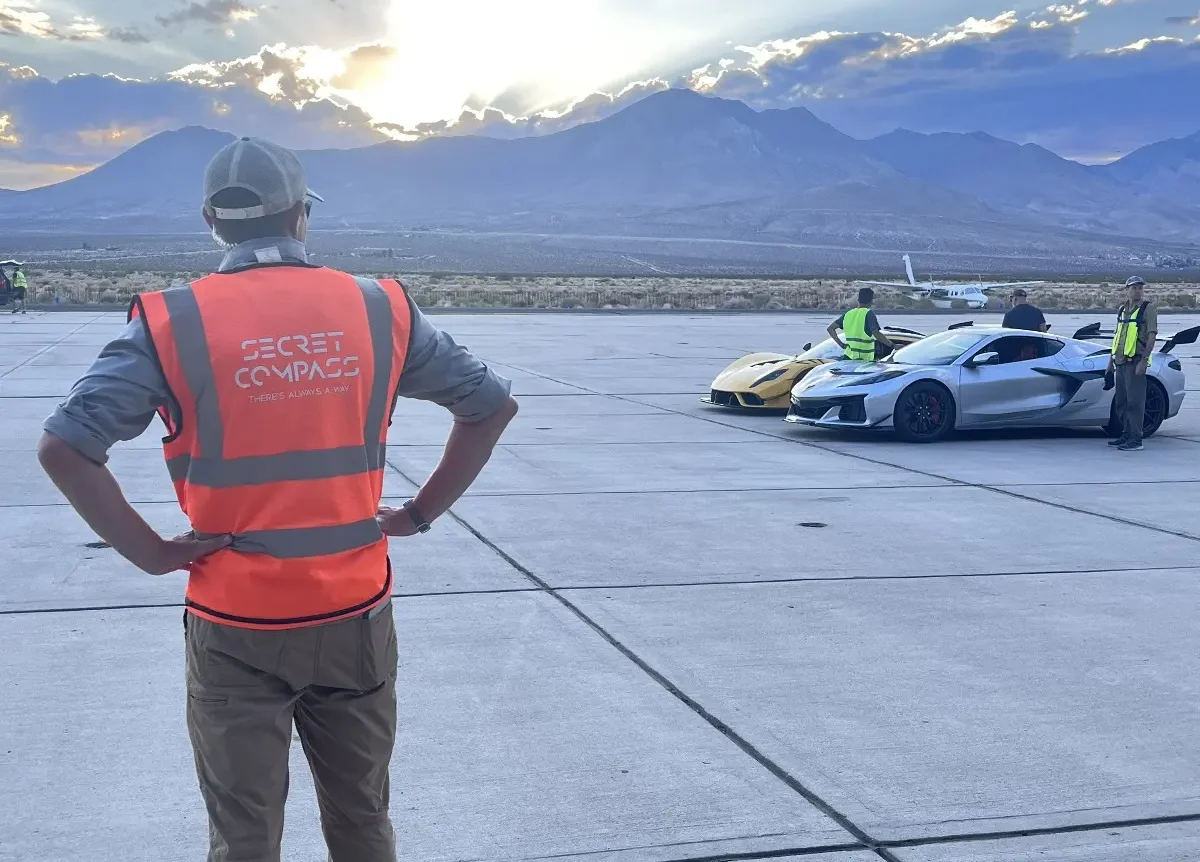
One of the most ambitious sequences on the series involved three supercars racing three fighter jets in a relay in California.
It wasn’t just cars and aircraft.
Helicopters and drones were also involved, creating a complex operating picture with multiple moving elements that all needed to work together. The filming window was tightly constrained by air traffic control, meaning the production had to get onto the runway, film the sequence and get off again within a short period of time.
For Secret Compass, the challenge was not simply assessing each element individually. It was making sure the whole operation worked as one plan.
That meant coordinating with the production team, aircraft, drivers, camera operators and presenters so that everyone understood what was happening and what their role was.
As Tom explains:
“Everyone understood exactly what the plan was, so it could run smoothly. There’s loads of potential for people not to understand the plan, and that’s what causes the issue.”
The finished sequence is designed to look effortless.
The planning behind it is anything but.
Risk management should enable the ambition
There is a misconception that bringing risk management into a production means making the idea smaller.
On Grand Tour, the objective was different.
The show is built around ambitious, high-risk activities. The role of risk management was not to remove that ambition, but to understand what it would take to deliver it safely.
That means asking difficult questions early, when there is still time to solve them.
What vehicle should be used? What training is required? What does the location allow? What needs to be controlled? What happens if conditions change? What support needs to be in place?
Those questions don’t necessarily lead to a less ambitious sequence.
They can be what makes the ambitious sequence possible.
The work viewers never see
Grand Tour was being developed for around 15 months, from the first recce in August 2024 through to the final shoot in December 2025.
During that time, some locations were explored and ultimately didn’t make it to production. Others developed into shoots. Across the series, Secret Compass worked on the main international shoots as well as a number of smaller productions in the UK and Europe.
For the viewer, none of that process is visible.
What they see is the moment.
The car moving. The aircraft taking off. The presenters reacting. The apparent decision to do something completely ridiculous.
That illusion of spontaneity is part of what makes factual entertainment work.
But behind the spontaneity is a process: scout, recce, assess, train, brief, coordinate and shoot.
The better that process works, the less of it the audience ever needs to know about.
What production leaders can take from it
The biggest lesson isn’t that ambitious stunts require more paperwork.
It’s that risk expertise is most useful when it becomes part of the planning process early enough to influence how something will be done.
By the time a crew is standing on a runway, a track or a remote road with cameras rolling, most of the important safety decisions should already have been made.
That doesn’t mean knowing exactly what will happen.
It means understanding what could happen, planning for it, and giving the production the best possible chance of delivering the sequence it set out to make.
Because the most convincing spontaneous moments on screen are often the result of a lot of very deliberate work behind the scenes.
About the author
Tom Bodkin is Director and Co Founder at Secret Compass, a specialist risk management consultancy for TV and film productions operating in complex and remote environments worldwide.